Why Dele Momodu May Be Atiku’s Smartest Running Mate Option Yet
By Michael Abimboye
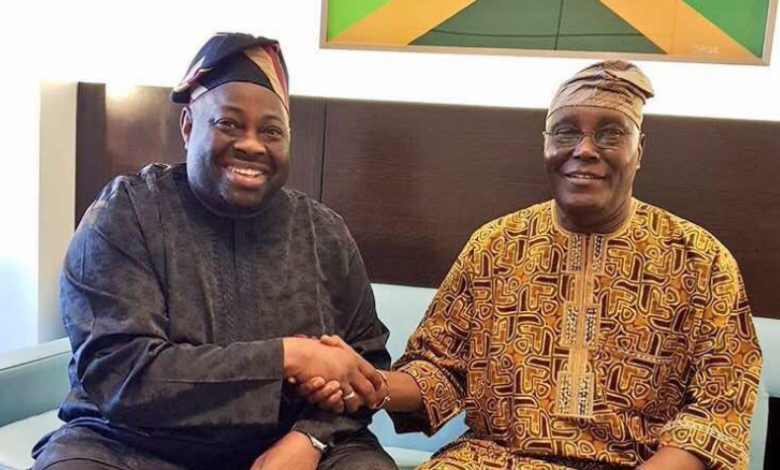
As the African Democratic Congress, ADC, gradually consolidates its coalition ahead of the 2027 presidential election, attention has inevitably shifted from the emergence of Atiku Abubakar as presidential candidate to the more delicate and strategic question of his running mate.
Several names have surfaced in political calculations and media speculation: Rotimi Amaechi, Emeka Ihedioha, and Dele Momodu, among them. Yet, beyond the noise of conventional political arithmetic lies a deeper electoral question: who among these options best expands Atiku’s coalition beyond traditional structures and into the modern political battlefield Nigeria has become?
Increasingly, the answer may well be Dele Momodu.
For years, Nigerian politics has operated under an outdated assumption that electoral victory is secured merely through governors, party leaders, and regional strongmen. The 2023 election disrupted that orthodoxy. The emergence of Peter Obi demonstrated that digital momentum, perception management, emotional resonance, and transregional appeal can significantly alter the political equation. Obi’s strongest weapon was not necessarily party structure. It was narrative dominance.
That reality has permanently changed Nigerian politics.
Exposed!! Popular Abuja doctor revealed how men can naturally and permanently cure poor erection, quick ejaculation, small and shameful manhood without side effects. Even if you are hypertensive or diabetic . Stop the use of hard drugs for sex!! It kills!
And in the current ADC coalition conversation, Dele Momodu may be one of the few figures who intuitively understands this new political environment.
Unlike many career politicians whose influence remains confined to state structures or elite caucuses, Momodu operates in multiple political ecosystems simultaneously: media, diplomacy, youth engagement, elite networking, pan-African influence, and digital communication. In modern electoral politics, that multidimensional relevance matters enormously.
One of Momodu’s most understated assets is his continental reach. Through decades of media work, political engagement, and elite interaction across Africa, he has cultivated relationships with presidents, former presidents, business leaders, diplomats, and intellectual figures across the continent. His network is not speculative mythology. It is publicly visible and historically documented through his long-running engagements as publisher of Ovation International and participant in high-level African political circles.
At a time when Nigeria seeks to reassert itself diplomatically and economically within Africa, such soft-power capital becomes politically valuable. A vice-presidential candidate today is no longer merely a ceremonial electoral appendage. He must also communicate competence, cosmopolitanism, and international legitimacy.
Momodu fits that profile more naturally than many conventional politicians. There is also the geographical intelligence behind his potential candidacy.
Though widely perceived nationally as a South-West figure because of his strong Yoruba cultural identity and media dominance in Lagos and the South-West, Dele Momodu is fundamentally from the South-South axis through his Edo roots. Politically, this creates a rare advantage. It allows the ADC to potentially tap into two strategic regions simultaneously without provoking the sharp regional anxieties that often accompany vice-presidential selections.
Amaechi, for instance, undoubtedly possesses political experience and administrative depth. But his polarising history in Rivers politics, coupled with his own presidential ambitions, complicates the chemistry required of a running mate. Indeed, reports have repeatedly suggested Amaechi has little interest in a vice-presidential role.
Ihedioha, meanwhile, brings stability and technocratic moderation, but lacks the national media visibility and emotional connection necessary for a fiercely competitive national election. Elections are not won only by competence. They are won by energy, narrative, symbolism, and visibility.
Dele Momodu possesses all four.
Then comes perhaps the most important factor of all: communication.
The 2027 election is unlikely to resemble previous Nigerian elections. It will be heavily digitised, media-driven, youth-influenced, and psychologically contested online. The political establishment still underestimates how profoundly social media has altered electoral mobilisation. The Obi movement in 2023 proved that online enthusiasm can shape national conversation, pressure traditional media, influence undecided voters, and energise urban youth demographics.
Momodu enters this terrain with an already established digital infrastructure.
Unlike many politicians who outsource communication to media aides, Dele Momodu himself is a communication institution. He understands headlines, optics, timing, public emotion, narrative construction, and audience psychology. His social media platforms command enormous engagement across demographics that traditional politicians often struggle to reach organically.
That matters.
In a coalition environment where ADC must unify disillusioned PDP voters, attract soft Obidients, retain Northern numerical strength, and penetrate urban youth constituencies, communication sophistication becomes central to survival.
Momodu also carries an outsider-insider advantage. He is politically experienced enough to understand power, yet sufficiently detached from the toxic baggage of conventional Nigerian political warfare. He has not governed a state, which critics may see as a weakness, but which supporters may frame as insulation from corruption controversies and governance fatigue associated with many old political actors.
In an anti-establishment electoral climate, that distinction could become useful.
Perhaps most importantly, Dele Momodu brings cultural elasticity. He can comfortably engage traditional rulers in Kano, intellectuals in Abuja, media elites in Lagos, young digital audiences in Port Harcourt, diaspora professionals in London, and political moderates in the South-East. Very few Nigerian political figures possess that adaptive national reach without appearing artificial.
And politics, ultimately, is the management of coalitions.
Atiku’s greatest challenge is not merely winning Northern votes. He already possesses substantial Northern recognition. His real challenge is rebuilding emotional trust across sections of Southern Nigeria while simultaneously energising younger demographics sceptical of establishment politics.
A conventional politician may help him consolidate structures.
Dele Momodu, however, may help Atiku reshape perception. And in modern politics, perception is often the first battlefield victory.