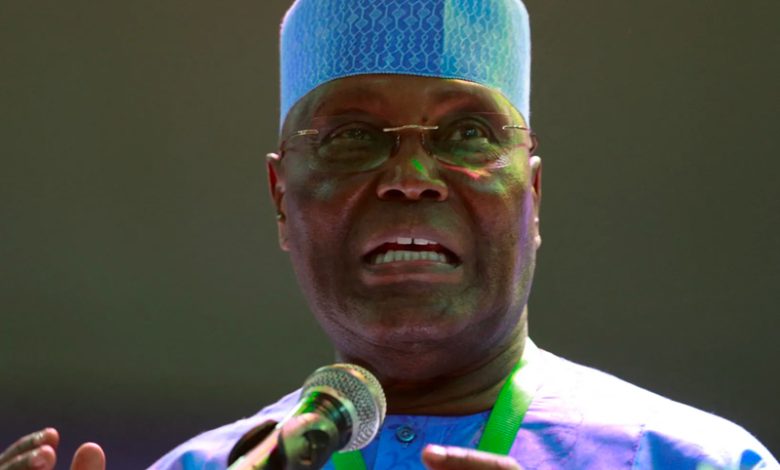
Former Vice President and ADC presidential candidate Atiku Abubakar has accused President Bola Tinubu’s administration of undermining Nigeria’s agricultural sector, saying farmers are battling insecurity while manufacturers grapple with soaring production costs and declining export earnings.
Atiku said the administration’s economic policies had failed to deliver the productive economy promised to Nigerians, arguing that the country continues to export raw agricultural commodities while losing the jobs, investments and value that domestic processing could create.
In a statement issued on Tuesday by Phrank Shaibu, Director of Strategic Communication of the ADC Presidential Campaign Council, Atiku cited agricultural trade figures which, he said, expose the depth of the problem.
According to the figures cited by Atiku, Nigeria’s agricultural trade moved from a ₦740.27 billion surplus in the first half of 2025 to a ₦56.13 billion deficit in the corresponding period of 2026, representing a ₦796.40 billion reversal in one year.
Agricultural exports, he added, declined by 33.3 per cent during the period.
“Tinubu cannot call this reform when the people who grow our food and the businesses that should process it are being squeezed from both sides,” Atiku said.
Exposed!! Popular Abuja doctor revealed how men can naturally and permanently cure poor erection, quick ejaculation, small and shameful manhood without side effects. Even if you are hypertensive or diabetic . Stop the use of hard drugs for sex!! It kills!
He rejected the argument that the figures were simply the result of increased imports, insisting that the more fundamental concern was Nigeria’s declining capacity to earn from agricultural exports.
“The excuse that Nigerians simply imported too much will not stand. Tinubu’s government must answer for the collapse in what Nigeria sold to the world,” he said.
Atiku questioned what the administration had done to make farming safer, reduce the cost of transporting agricultural produce, sustain manufacturing and make Nigerian products more competitive in international markets.
“Farmers cannot cultivate promises. Manufacturers cannot power factories with speeches. Workers cannot feed their families on assurances that prosperity is coming,” he said.
‘Nigeria Exports Raw Materials, Others Take the Value’
Atiku also criticised Nigeria’s continued reliance on the export of largely unprocessed agricultural commodities, pointing to cashew nuts and cocoa beans among the country’s major agricultural exports.
According to him, Nigeria produces the raw materials while other countries capture a greater share of the economic value through processing, manufacturing and global distribution.
“We grow the crop. Someone else does more of the processing, builds a business around it and earns the larger return,” Atiku said.
He argued that the situation was inconsistent with the administration’s promise to create jobs and build a productive economy.
“A trade deficit alone does not explain every problem on our farms. But after more than three years in office, the President owns the decisions that have left farmers exposed and producers burdened,” he said.
Atiku Revives Local Refining Subsidy Proposal
The ADC presidential candidate also linked his agricultural policy criticism to his proposal for a production subsidy on petroleum products refined in Nigeria.
Under the proposal, he said, qualifying products produced by Nigerian refineries, including modular refineries, would receive government support, while imported products would be excluded.
He said the programme would be capped, budgeted and independently audited, with mechanisms to ensure that the benefits translate into lower costs for consumers and businesses.
Atiku further criticised the Tinubu administration’s Compressed Natural Gas initiative, describing it as an ineffective relief measure for many Nigerians because of the cost and limited availability of conversion kits.
“The cost of converting vehicles is beyond the reach of many poor Nigerians, conversion kits are difficult to access, and the buses presented as palliatives remain unavailable to many of the people who need them,” he said.
Atiku argued that the impact of local refining extends beyond petrol prices, noting that aviation fuel, LPG and petroleum feedstocks directly affect transportation, household energy costs, industrial production and employment.
“Nigerians need practical relief they can actually access, not schemes whose costs and shortages put the promised benefits out of reach,” he said.
‘Grow It Here. Process It Here. Refine It Here.’
Atiku promised that an ADC administration would prioritise domestic production and value addition across agriculture and the petroleum sector.
“My administration will begin restoring a transparent production subsidy from Day One. We will back farmers and processors with the same determination,” he said.
“Grow it here. Process it here. Refine it here. Create the jobs here. Make life affordable here.”
He accused the Tinubu administration of presiding over an economy in which Nigeria exports raw agricultural products and crude oil while importing finished goods at significantly higher costs.
“Tinubu’s record is becoming painfully clear: Nigeria supplies raw crops and crude oil while Nigerians pay dearly for finished goods,” Atiku said.
“A government that cannot turn our resources into affordable products and decent jobs has failed the people it was elected to serve.”
The statement was signed by Phrank Shaibu, Director of Strategic Communication, ADC Presidential Campaign Council.